How to Choose Hydraulic Fittings: A Professional Guide for Industrial Systems
TABLE OF CONTENTS
-
Key Takeaways
-
The Strategic Importance of Hydraulic Fitting Selection
-
The STAMPED Method: A Framework for Choosing Fittings
-
Identifying Thread Standards and Connection Types
-
Environmental Factors in the Saudi Industrial Landscape
-
Optimizing Performance with ETS Technical Support
-
Secure Your Operations with Precision-Engineered Fittings
-
Frequently Asked Questions
Introduction
What if a single mismatched thread on a 75 SAR component is the only thing standing between your project deadline and a 20,000 SAR per hour shutdown? Most maintenance engineers in Dammam and Jubail agree that even a minor leak isn't just a mess; it's a serious safety hazard and a massive drain on your operational efficiency. You've likely felt the frustration of trying to force an NPT fitting into a BSP port or watching a standard seal fail prematurely under the 50°C heat of a Saudi summer. Mastering how to choose hydraulic fittings properly is the primary difference between a reliable system and one that constantly demands expensive, unscheduled repairs.
We've engineered this guide to help you master the technical criteria required for a zero-leak industrial environment. You'll learn how to navigate complex international thread standards and select materials that withstand high-pressure demands without failing in harsh desert conditions. This professional overview provides a clear roadmap to ensure your new components are fully compatible with existing Parker or Rexroth systems, allowing you to extend your equipment's service life and optimize your facility's total uptime.
Key Takeaways
• Understand why a "near-match" fitting is a leading cause of industrial leaks and how precision selection ensures reliable system performance.
• Master the industry-standard STAMPED framework to learn precisely how to choose hydraulic fittings that meet every technical and safety requirement.
• Navigate the complexities of global thread standards to eliminate the risk of cross-threading and ensure secure connections across your machinery.
• Identify specialized strategies to protect hydraulic seals and threads from the extreme heat and abrasive sand unique to the Saudi Arabian environment.
• Discover how partnering with local experts like Emdad Technical Services provides the global parts and technical support needed to optimize downtime.
The Strategic Importance of Hydraulic Fitting Selection
Hydraulic fittings serve as the critical interface between hoses, rigid pipes, and core system components like pumps and actuators. These components do more than just connect; they maintain the seal that keeps your entire operation pressurized. Understanding how to choose hydraulic fittings is a fundamental engineering requirement for any facility manager in Saudi Arabia, where ambient temperatures often exceed 50 degrees Celsius and high-pressure demands are standard. A common mistake in local workshops is the use of a "near-match" fitting. While it might thread on initially, a 0.5mm difference in thread pitch or an incorrect seat angle is the primary cause of industrial leaks. These small discrepancies lead to 15% of all hydraulic system failures within the first 72 hours of operation after a repair. Adhering to established piping and plumbing fitting standards ensures that every connection point can withstand the 400 Bar pressures often found in heavy industrial Hydraulic Power Units (HPUs).
Modern hydraulic systems in the Kingdom are moving toward zero-leak technology as a mandatory standard. In the past, a small amount of "weeping" at a joint was tolerated, but current environmental and efficiency goals make this unacceptable. Zero-leak technology, such as O-Ring Face Seals (ORFS), provides a robust mechanical and chemical barrier against fluid loss. When you master how to choose hydraulic fittings, you aren't just buying a part; you're investing in the long-term reliability of a system that might be worth millions of SAR.
Fittings as a Component of System Integrity
Fittings must manage high-velocity fluid flow and sudden pressure spikes without losing their seal. In construction and mining sites across Riyadh and the Eastern Province, heavy equipment faces constant vibration. A fitting that lacks proper vibration resistance will loosen over time, leading to fluid loss and potential fire hazards. Proper selection is a non-negotiable safety requirement. It's the difference between a productive shift and an emergency evacuation. High-quality fittings ensure that flow remains laminar, reducing heat generation and extending the life of hydraulic oil, which can cost over 40 SAR per liter for premium synthetic grades.
The Cost of Incorrect Selection
The financial consequences of a poor choice are severe and immediate. In the Saudi Oil and Gas sector, a single hour of unplanned downtime on a drilling rig can cost an operator upwards of 95,000 SAR in lost production and idle labor. Beyond immediate mechanical repairs, environmental hazards pose a significant risk. A leak of just one drop per second results in the loss of 1,550 liters of hydraulic fluid annually, costing approximately 22,000 SAR in wasted consumables alone, excluding the 30,000 SAR average cost for environmental remediation of contaminated soil. Catastrophic fitting failure in high-pressure HPUs represents the sudden, uncontrolled release of pressurized fluid that results in immediate system shutdown, potential equipment destruction, and severe risk of pinhole injection injuries to nearby personnel.
• Downtime Impact: 15% to 20% reduction in annual output for facilities with chronic leak issues.
• Safety Risks: High-pressure pinhole leaks can penetrate human skin at distances of up to 10 centimeters.
• Resource Waste: Incorrectly matched threads account for 40% of all reported fitting replacements in KSA mining operations.
The STAMPED Method: A Framework for Choosing Fittings
Selecting the wrong component can lead to system-wide failure, costing your operation thousands of SAR in lost productivity. To mitigate this risk, industry experts rely on the STAMPED method. This acronym serves as a non-negotiable technical checklist for anyone learning how to choose hydraulic fittings with precision. By following these seven criteria, you eliminate guesswork and prevent 90% of common specification errors:
S.T.A.M.: Size, Temperature, Application, and Material
• Size (S): Professionals use "Dash Sizes," which represent the inside diameter in 1/16-inch increments (e.g., a -12 hose has an inside diameter of 3/4 inch). Sizing errors cause excessive fluid velocity, flow restrictions, and massive heat generation. Calculate flow diameter requirements based on the maximum pump flow rate (GPM/LPM) to prevent efficiency-sapping pressure drops.
• Temperature (T): Must account for both fluid temperature (which can reach 120°C in heavy machinery) and ambient environmental temperatures exceeding 45°C to 50°C in the Eastern Province. Standard Nitrile (NBR) O-rings become brittle and fracture; high-heat applications require Viton (FKM) or specialized fluorocarbon elastomers.
• Application (A): Defines dynamic mechanical stress, external vibration, and physical routing constraints. A static load on a stationary press requires different reinforcement than a dynamic, vibrating excavator boom. Precision high-pressure torque wrenches are essential for secure field installation.
• Material (M): Dictates corrosion resistance and working life. Carbon steel is standard for general industrial hydraulics, whereas 316 Stainless Steel is mandatory for offshore marine rigs and coastal facilities near Dammam to resist salt-spray corrosion. Brass is reserved for low-pressure pneumatic circuits.
P.E.D.: Pressure, Ends, and Delivery
• Pressure (P): Working pressure ratings must meet or exceed maximum system working pressure, including surge spikes. Engineers mandate a 4:1 design safety factor (a fitting operating at 3,000 PSI must possess a burst threshold of 12,000 PSI).
• Ends / Threads (E): Adhere to established technical standards like SAE J516 defining geometry and threading for JIC, ORFS, and NPT connections to ensure leak-free seals under load.
• Delivery (D): Sourcing parts locally is vital when rig or plant downtime costs 15,000+ SAR per hour. Emdad Technical Services provides rapid delivery across the Eastern Province, eliminating the 48-hour to multi-week delays of overseas freight.
Summary Overview: The High Cost of a Mismatch
• Single Mismatched Fitting: A 75 SAR fitting with a slight 0.5mm thread discrepancy can lead to a 20,000 SAR/hour shutdown.
• Extreme Environmental Factors: Ambient temperatures exceeding 50°C, operating pressures up to 400 Bar in heavy HPUs, and abrasive silica dust demand absolute seal integrity.
• The STAMPED Framework: Systematic verification of Size, Temperature, Application, Material, Pressure, Ends, and Delivery prevents 90% of specification errors.
Identifying Thread Standards and Connection Types
The Saudi industrial sector relies on machinery sourced globally, creating complex environments where multiple thread standards coexist on a single machine. Misidentifying a thread is a safety hazard leading to 15,000 SAR or more in equipment damage and lost productivity per incident.
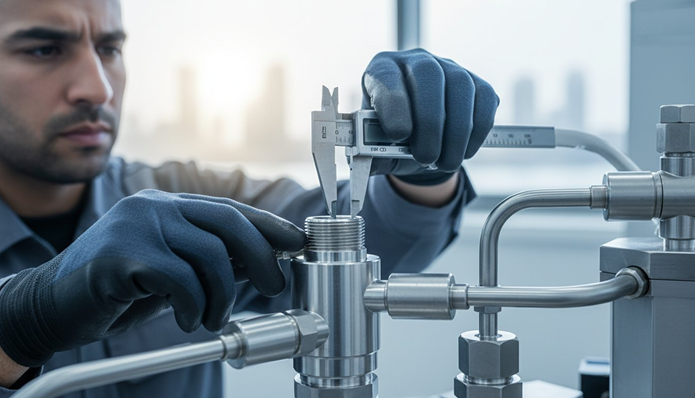
Cross-threading occurs when a technician forces a fitting with one pitch into an incompatible port (e.g., an American NPT fitting forced into a British BSP port, where thread angles differ by 5 degrees). Forcing them together destroys the threads and guarantees a high-pressure blowout. Always verify connections using digital calipers and thread pitch gauges to record outside diameter (OD) and threads per inch (TPI) or metric pitch.
American vs. British vs. Metric Standards
• NPT / NPTF (National Pipe Tapered): North American standard (common on Caterpillar machinery). Seals through metal-to-metal thread interference as tapered flanks wedge together.
• BSP (British Standard Pipe): Common on European machinery; available as BSPP (parallel thread requiring an elastomeric seal) and BSPT (tapered thread).
• Metric Threads (DIN): Global standard for modern manufacturers like Bosch Rexroth and Parker. Over 65% of new industrial hydraulic installations in Saudi Arabia utilize Metric DIN fittings due to tight tolerances and extreme pressure ratings.
Sealing Methods: Tapered Threads vs. Mechanical Joins
• JIC 37° Flare: Relies on metal-to-metal contact between the flared fitting nose and female cone seat, handling pressures up to 6,000 PSI without an elastomer.
• O-Ring Face Seal (ORFS): Features an elastomeric O-ring embedded in the flat face of the fitting. Eliminates the risk of over-tightening fractures and delivers superior leak resistance in high-vibration systems.
Environmental Factors in the Saudi Industrial Landscape
Operating heavy machinery in Saudi Arabia requires specialized engineering adaptations that standard global datasheets overlook:
Managing Thermal Expansion and Seal Integrity
In Riyadh, the Empty Quarter, and eastern industrial corridors, 50°C ambient temperatures push internal fluid temperatures beyond 90°C. Standard Nitrile (NBR) seals harden, lose elasticity, and begin weeping fluid. Viton (FKM) seals withstand temperatures up to 200°C without structural degradation. Although Viton carries a 15% price premium, its ability to prevent unscheduled shutdowns makes it the most economical choice.
Corrosion Resistance and Regional Coating Standards
Coastal humidity and salt-laden air in Jubail and Dammam can rust standard galvanized fittings in under 120 days:
• Zinc-Nickel (ZnNi) Plating: The modern industrial benchmark, offering over 1,000 hours of red-rust salt spray resistance—nearly 10 times the protection of traditional hexavalent chrome.
• 316 Stainless Steel: Mandatory for offshore platforms, marine vessels, and facilities situated within 5 kilometers of the Arabian Gulf.
Summary of Regional Material Specifications
• Inland (Riyadh / Qassim): Carbon steel with Zinc-Nickel plating and Viton seals to withstand dry ambient heat and dust.
• Coastal Industrial (Jubail / Yanbu): Zinc-Nickel plating mandatory; 316 Stainless Steel preferred for exposed outdoor lines.
• Offshore / Marine: Exclusively 316 Stainless Steel or specialized corrosion-resistant alloys.
• High-Dust Environments: Mandatory use of heavy-duty protective caps and plugs during disconnections to prevent abrasive silica from scouring threads.
Optimizing Performance with ETS Technical Support
Emdad Technical Services (ETS) bridges global engineering quality with local Saudi Arabian operational demands:
• Immediate Brand Sourcing: Direct local inventory of genuine Parker, Rexroth, and Eaton components, eliminating 4- to 6-week international shipping lead times.
• Custom Fabrication: In-house machining of custom manifolds, bespoke flange adapters, and specialized fittings rated for extreme pressures exceeding 700 Bar.
• Legacy & Obsolete Thread Matching: Leveraging decades of regional field expertise to accurately identify rare European and American legacy threads, preventing costly trial-and-error mismatches.
• System-Wide Fluid Power Solutions: Integrating fitting selection with custom HPU fabrication, filtration audits, and preventive maintenance to lower total cost of ownership (TCO) by up to 22%.
Secure Your Operations with Precision-Engineered Fittings
Precision selection of hydraulic fittings is the frontline defense against expensive leaks, worksite hazards, and unscheduled plant downtime. Emdad Technical Services combines extensive inventory in Dammam with deep technical support to keep your operations running safely and efficiently.
Consult with our engineering specialists today for precision hydraulic fittings at etsarabia.com.
Frequently Asked Questions (FAQs)
How do I identify the difference between NPT and BSP threads?
Measure the thread flank angle and pitch profile: NPT threads feature a 60-degree angle with truncated (flat) peaks and roots, whereas BSP threads feature a 55-degree angle with rounded crests and roots. They are not interchangeable.
What are the most common causes of hydraulic fitting leaks?
Improper tightening torque and incorrect thread identification account for roughly 85% of all leaks. Over-tightening deforms mating seats and cracks female flare nuts, while under-tightening leaves gaps that fail under operational pressure spikes.
Can I reuse hydraulic fittings after they have been disconnected?
Reusing flared (JIC) or bite-type compression fittings is not recommended because metal-to-metal sealing surfaces undergo permanent plastic deformation during initial tightening. Reusing them increases blowout risks by 45%. For ORFS fittings, always install a fresh O-ring prior to reconnection.
What is a Dash Size and how do I calculate it?
Dash Size denotes the nominal internal diameter in sixteenths of an inch (1/16"). Multiply the fractional inch measurement by 16 (e.g., 1/2" diameter = -8 Dash Size; 3/4" diameter = -12 Dash Size).
Why is an O-Ring Face Seal (ORFS) considered better for high-vibration systems?
ORFS fittings seat against a flat elastomeric O-ring that absorbs high-frequency vibrations (60 Hz+) without backing off or galling the mating metal face, ensuring long-term leak-free performance under heavy cyclical shock loads.