Hydraulic Power Unit Rental in Saudi Arabia: A 2026 Project Guide
TABLE OF CONTENTS
-
Key Takeaways
-
What is a Hydraulic Power Unit & Why is it Critical for Saudi Industries?
-
Evaluating HPU Rental in Saudi Arabia: Pros and Cons
-
The Strategic Alternative: Investing in a Custom-Fabricated HPU
-
Rent vs. Buy: Your HPU Decision Framework
-
Why Saudi Industries Partner with ETS for Custom HPUs
-
Securing Your Project's Success: The Right HPU Strategy
-
Frequently Asked Questions
Introduction
Project deadlines in Saudi Arabia's booming industrial sector are non-negotiable, and a critical project stall due to unreliable hydraulic power is a risk you cannot afford. The wrong equipment sourcing decision can lead to catastrophic downtime and budget overruns costing thousands of Saudi Riyals. When navigating the options for hydraulic power unit rental in Saudi Arabia, how can you be certain it's the right financial and operational choice over a long-term purchase? This uncertainty can be as costly as the downtime itself.
This 2026 project guide is engineered to provide that clarity. We will explore the critical factors that determine when a rental HPU is the most efficient solution for your project's timeline and budget. More importantly, we will outline when investing in a custom-built unit from Emdad Technical Services (ETS) becomes the superior strategy for guaranteeing performance and minimizing operational risk. Prepare to make a confident, financially sound decision and secure a reliable partner who understands the unique demands of the KSA market.
Key Takeaways
• Learn to identify the exact project scenarios—like urgent, short-term needs—where a hydraulic power unit rental Saudi Arabia is the most strategic and cost-effective choice.
• Discover how a custom-fabricated HPU delivers superior long-term ROI and operational efficiency, often outweighing the initial investment cost in SAR.
• Access a practical rent-vs-buy decision framework to confidently assess the right HPU solution for your project's specific technical and financial requirements.
• Understand why partnering with a local expert for HPU fabrication ensures your unit is optimized for Saudi Arabia's demanding industrial conditions and backed by prompt, in-Kingdom support.
What is a Hydraulic Power Unit & Why is it Critical for Saudi Industries?
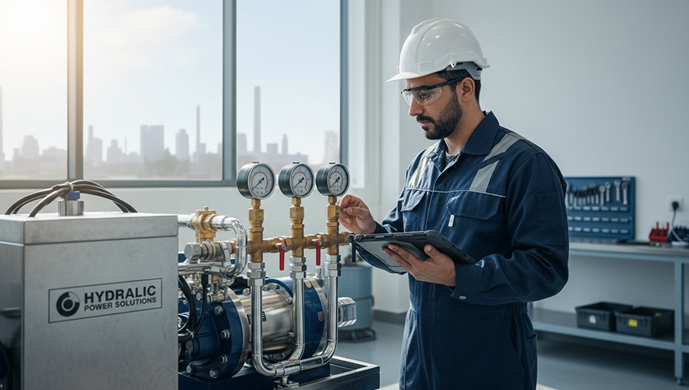
A Hydraulic Power Unit (HPU) is the heart of any hydraulic system, serving as the prime mover that converts primary energy into hydraulic fluid power. This pressurized fluid is then used to drive machinery, tools, and equipment with immense force and precision. In the demanding industrial landscape of Saudi Arabia, from the oil fields of the Eastern Province to the giga-projects reshaping the west, HPUs are the unseen engines that guarantee operational continuity and productivity.
A robust HPU is an integrated system of critical components working in unison: • Motor: An electric motor or diesel engine that provides the initial mechanical prime mover power.
• Reservoir: A tank designed to hold, cool, and de-aerate the hydraulic fluid.
• Pump: Creates the flow of hydraulic fluid, converting mechanical torque into fluid energy.
• Valves: Directional, flow, and pressure control valves directing fluid safely to actuators.
• Heat Exchanger: Regulates fluid temperature to prevent fluid breakdown in extreme summer desert conditions.
Core Applications in the Kingdom
• Oil & Gas: Powering drilling equipment, blowout preventers (BOPs), and wellhead control panels across onshore and offshore sites.
• Construction: Operating heavy machinery such as crawler cranes, excavators, high-tonnage piling rigs, and concrete pre-cast presses.
• Marine & Shipping: Powering anchor windlasses, dynamic steering gear, stabilizers, and cargo hatch covers operating in the Arabian Gulf and Red Sea.
Standard HPUs vs. Custom Solutions
Standard off-the-shelf rental units serve generic, temporary workloads well. However, specialized heavy-industrial installations demand precision pressures, matched liter-per-minute flow profiles, and high-efficiency thermal control. Deploying a mismatched generic unit causes energy throttling, overheating, and sudden system outages.
Evaluating HPU Rental in Saudi Arabia: Pros and Cons
Renting offers tactical agility for immediate operational shortages, but it is accompanied by operational trade-offs:
Advantages of Renting an HPU
• Preservation of Capital: No upfront capital expenditure, preserving cash reserves in Saudi Riyals (SAR) for ongoing operational requirements.
• Ideal for Defined Timelines: Cost-effective for short turnaround jobs, test runs, or serving as a temporary bridge while primary plant units undergo overhaul.
• No Maintenance Overheads: Preventive servicing, fluid replacements, and component repairs remain the contractual responsibility of the rental fleet provider.
Disadvantages and Hidden Risks of Rental
• Generic "One-Size-Fits-All" Compromises: Standard rental frames rarely match bespoke pressure and flow curves, driving electrical inefficiency and slow actuator cycle times.
• Unknown Maintenance Integrity: Rental units often come with mixed service histories, increasing the risk of sudden worksite failure during round-the-clock operations.
• Runaway Rental Costs: Projects subject to unforeseen timeline extensions accumulate monthly rental fees that can rapidly surpass the cost of fabricating a dedicated permanent HPU.
The Strategic Alternative: Investing in a Custom-Fabricated HPU
For plants with continuous operational cycles, investing in a custom HPU transforms an ongoing rental expense into a durable, high-yield capital asset:
Maximizing ROI and Performance
• Tailored Volumetric Delivery: Fabricated strictly to machine duty-cycle parameters, reducing power waste and cutting utility bills.
• Elimination of Rental Risk: Operating a brand-new, factory-tested unit removes downtime caused by pre-worn rental machinery.
• Long-Term Asset Valuation: Custom-engineered systems maintain high residual asset value and offer multi-year lifecycle guarantees.
Engineered for Saudi Arabia's Severe Operating Conditions
Off-the-shelf rental HPUs struggle in high-heat, dusty environments. Custom units fabricated by ETS in Dammam feature specialized protections: • High-Capacity Tropicalized Coolers: Sized to maintain reservoir temperatures below 60°C even when regional ambient heat tops 50°C.
• Desert Air & Fluid Filtration: Multi-stage desiccant air breathers and sealed reservoirs to prevent abrasive silica dust contamination.
• Industrial Standard Compliance: Fabricated strictly in accordance with Saudi Aramco, SABIC, and Royal Commission engineering criteria.
Rent vs. Buy: Your HPU Decision Framework
| Decision Factor | HPU Rental | Custom HPU Purchase |
| Project Duration |
Ideal for short timelines (< 3 to 6 months) or emergency unit backups. |
Financially optimal for long-term or permanent industrial installations. |
| Application Specificity |
Best for general-purpose fluid supply where standard ratings suffice. |
Mandatory for specialized machines requiring exact pressures, flows, or ATEX zones. |
| Budget Structure |
OPEX (Operating Expense) with predictable monthly payments and low upfront commitment. |
CAPEX (Capital Expenditure) requiring upfront allocation but building long-term equity. |
| Maintenance Burden |
Managed entirely by the rental fleet supplier. |
Managed internally or via scheduled service contracts with ETS. |
| Lead Time |
Immediate dispatch from available rental fleets. |
8 to 12 weeks for precision engineering, assembly, and testing. |
Why Saudi Industries Partner with ETS for Custom HPUs
Emdad Technical Services (ETS) delivers complete hydraulic engineering solutions from our specialized facility in Dammam:
• World-Class Components: We engineer custom HPUs using genuine pumps, manifolds, and valves from top brands like Parker, Eaton, and Bosch Rexroth.
• Complete In-House Process:
-
Step 1: Technical Consultation: Defining flow rates, operating pressure, duty cycles, and environmental specs.
-
Step 2: 3D CAD Modeling: Creating detailed fluid schematics and space-saving enclosure layouts.
-
Step 3: Precision Fabrication & Bench Testing: Certified welding, clean piping, and full-load pressure testing on our calibrated test benches.
-
Step 4: On-Site Commissioning: Complete plant integration, electrical hookup validation, and operator training.
Securing Your Project's Success: The Right HPU Strategy
Whether your operational timeline requires an agile temporary rental or a high-efficiency custom power unit built for continuous desert operations, choosing the right hydraulic architecture is critical to avoiding costly plant shutdowns.
Emdad Technical Services combines local engineering manufacturing in Dammam with responsive field support across the Kingdom to keep your industrial operations moving forward.
Discuss your HPU rental or custom fabrication requirements with our engineering team at etsarabia.com.
Frequently Asked Questions (FAQs)
What is the typical lead time for a custom-built HPU from ETS?
The standard manufacturing lead time ranges between 8 to 12 weeks, depending on component availability, system complexity, and custom manifold fabrication. Expedited timelines can be evaluated for emergency plant requirements.
Can ETS repair or service our existing hydraulic power unit instead of replacing it?
Yes. ETS provides comprehensive troubleshooting, component rebuilds, pump overhauls, and full refurbishments for existing HPUs, restoring them to factory performance at a fraction of replacement costs.
What information do I need to provide to get a quote for a custom HPU?
Key specifications include maximum operating pressure (bar/psi), required output flow rate (L/min or GPM), reservoir capacity, prime mover type (electric motor voltage/frequency or diesel), ambient operating conditions, and valve control preferences (manual, solenoid, or proportional).
Do you serve projects outside of Dammam, such as in Riyadh or Jeddah?
Yes. Although our primary fabrication and test center is located in Dammam 2nd Industrial City, ETS supports industrial projects, petrochemical complexes, and infrastructure works throughout Riyadh, Jeddah, Jubail, Yanbu, and across Saudi Arabia.