Hydraulic Power Unit: The Complete Guide for Industrial Applications
TABLE OF CONTENTS
-
What is a Hydraulic Power Unit (HPU)?
-
The Core Components of a Hydraulic Power Unit Explained
-
How an HPU Works: The Step-by-Step Operating Cycle
-
Choosing Your HPU: Standard vs. Custom-Built Solutions
-
HPU Applications in Saudi Arabia's Key Industries
-
Maintenance and Troubleshooting for Your Hydraulic Power Unit
-
Your Partner for Optimized Hydraulic Power and Performance
-
Frequently Asked Questions About Hydraulic Power Units
Introduction
In the demanding industrial landscape of Saudi Arabia, selecting the right equipment is a critical decision that directly impacts operational efficiency and profitability. If you are navigating the complexities of hydraulic systems, trying to decipher technical specifications, or finding that standard units fail to meet your unique requirements, you are not alone. At the heart of any robust fluid power system is the hydraulic power unit (HPU)—the engine that drives your most critical machinery. Understanding its function is essential for minimizing costly downtime and maximizing productivity.
This comprehensive guide is engineered to provide the clarity and expertise you need. We will break down exactly what a hydraulic power unit is, explain how its core components work together to generate and control immense power, and outline the key criteria for choosing the right one for your industrial needs. Gain the confidence to specify the perfect HPU, whether standard or custom-fabricated, and find a reliable partner to ensure your systems are always in motion.
What is a Hydraulic Power Unit (HPU)?
Think of a hydraulic power unit (HPU) as the dedicated heart of any hydraulic system. In the same way an engine powers a car, an HPU is the central component that powers all forms of hydraulic machinery. Its primary function is to convert mechanical energy—typically from an electric motor or diesel engine—into efficient hydraulic power. This conversion process is fundamental to operations across demanding sectors in Saudi Arabia, from oil and gas extraction to large-scale construction.
The HPU accomplishes this by generating two critical outputs: fluid flow and pressure. Fluid flow (measured in litres per minute) determines the speed at which hydraulic cylinders or motors operate, while pressure (measured in bar or PSI) dictates the amount of force they can exert. By precisely managing these two variables, a hydraulic power unit provides the controlled strength needed to power heavy-duty equipment, ensuring your operations remain productive and efficient.
The Basic Principle: Pascal's Law in Action
The immense force generated by hydraulics is governed by a fundamental principle of fluid mechanics: Pascal's Law. This law states that pressure applied to an enclosed fluid is transmitted equally in all directions. An HPU leverages this by using a pump to pressurize hydraulic fluid within a contained system. This pressurized fluid then acts on components like cylinders, multiplying the initial force significantly. It is this core principle that enables compact hydraulic systems to lift multi-ton loads with unparalleled precision and control.
Why Use an HPU Instead of Direct Mechanical Drive?
• Force Multiplication & Precise Control: HPUs deliver immense power, allowing for the movement of extremely heavy loads. This power can be controlled with exceptional accuracy, enabling delicate and complex operations that are impossible with purely mechanical systems.
• Flexible System Design: The power source (the HPU) can be located remotely from where the work is performed (the actuator). This flexibility is vital for applications with space constraints, safety concerns, or harsh operating environments, simplifying machine design and maintenance.
• Superior Power Density & Durability: Hydraulic components are renowned for their high power-to-size ratio, packing significant force into a compact footprint. Built for demanding industrial conditions, they offer robust, long-lasting performance and unmatched reliability.
The Core Components of a Hydraulic Power Unit Explained
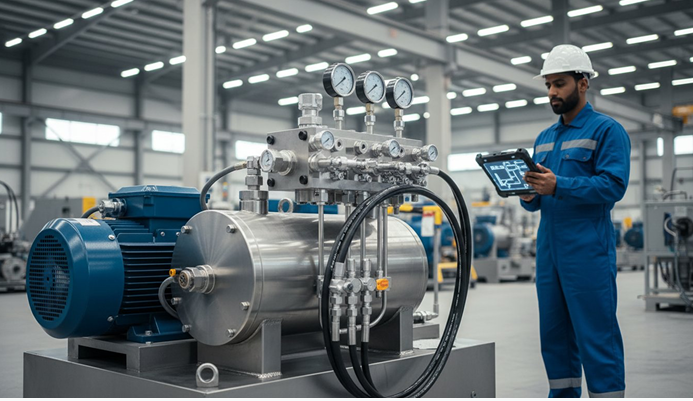
A high-performance hydraulic power unit is more than a collection of parts; it is a precisely engineered system designed for reliability and power. Its performance hinges on the quality and correct sizing of its core components, which can be grouped into three main areas:
1. Power Source: The Prime Mover and Pump
The heart of the HPU, this section generates the hydraulic power. The prime mover—typically a robust electric motor for industrial applications or a diesel engine for mobile equipment—provides the necessary rotational force. It drives the hydraulic pump (e.g., gear, vane, or piston pump), which converts this mechanical energy into fluid flow. The motor's power (kW) must be precisely matched to the pump's displacement and the system's pressure requirements to ensure optimal efficiency and prevent component overload.
2. Fluid Management: Reservoir, Filters, and Coolers
Effective fluid management is essential for the longevity and reliability of any hydraulic system, especially in the demanding industrial environments found in Saudi Arabia: • Reservoir: The tank does more than just hold fluid; it is engineered to dissipate heat, allow contaminants to settle, and separate entrained air from the oil.
• Filters: These are your system's primary defense, crucial for removing harmful particles that cause abrasive wear, protecting sensitive components, and preventing unexpected failures.
• Coolers & Heaters: In high-temperature climates, coolers are non-negotiable. They prevent fluid from overheating and losing its optimal viscosity, ensuring consistent and reliable performance day after day.
3. Control & Distribution: Valves, Accumulators, and Manifolds
This is the "brain" of the hydraulic power unit, expertly directing the fluid to perform precise work: • Valves: Directional, pressure, and flow control valves manage the fluid's path, force, and speed, allowing for precise command over actuators like cylinders and motors.
• Accumulator: A pressure vessel that stores hydraulic energy. It can supplement pump flow during moments of peak demand or absorb hydraulic shocks, protecting the system from damaging pressure spikes.
• Manifolds: These central blocks consolidate valves into a compact, integrated package. This design significantly reduces potential leak points, simplifies plumbing, and enhances overall system reliability.
How an HPU Works: The Step-by-Step Operating Cycle
Plaintext
[Reservoir] ---> [Pump + Prime Mover] ---> [Control Valves / Manifold] ---> [Actuator] ---> [Filters & Coolers] ---> [Reservoir]
• Step 1: Activation and Fluid Pressurization: The cycle begins when the prime mover is activated, driving the hydraulic pump. The pump draws hydraulic fluid from the reservoir through a suction filter to remove coarse contaminants. As the pump pushes fluid against downstream circuit resistance, pressure builds, preparing the fluid to do mechanical work.
• Step 2: Directing Power to the Actuator: Pressurized fluid flows through manifold channels and control valves, which regulate system flow, direction, and pressure. Fluid reaches actuators (cylinders or motors), where hydraulic energy is converted back into mechanical linear or rotary motion.
• Step 3: The Return Loop: Low-pressure exhaust fluid leaves the actuator and flows through return line filters to trap fine wear debris. The conditioned oil returns to the reservoir to cool, de-aerate, and rest before being cycled back through the pump.
Choosing Your HPU: Standard vs. Custom-Built Solutions
Standard Hydraulic Power Units
Standard off-the-shelf HPUs offer faster availability and lower initial investment, with costs starting from a few thousand Saudi Riyals (SAR). However, standard catalog configurations offer limited adaptability and may prove inefficient or short-lived when subjected to non-standard duties or harsh Middle Eastern operating conditions.
Custom-Built Hydraulic Power Units
A custom-engineered unit is essential for demanding operations across Oil & Gas, Marine, and heavy manufacturing: • Optimized Performance: Tailored specifically to your precise flow rate (LPM), pressure profile (bar), and duty cycle.
• Maximum Efficiency: Sized to prevent throttling losses, minimizing power draw and excess heat generation.
• Seamless Integration: Built to conform to exact footprint limits, skid requirements, and existing plant control architecture.
Key Design Parameters
• Operating Pressure (PSI/Bar) & Flow Rate (GPM/LPM): Determines displacement, motor sizing, and valve port geometry.
• Operational Environment: Ambient desert heat, sand/dust ingress, and hazardous area zone ratings (e.g., explosion-proof ATEX / IECEx).
• Duty Cycle: Intermittent vs. continuous running profiles dictating reservoir fluid dwell time and heat exchanger cooling capacities.
HPU Applications in Saudi Arabia's Key Industries
• Oil & Gas and Petrochemical: Powering drilling rigs, wellhead control consoles, pipeline isolation valves, and Blowout Preventers (BOPs) requiring explosion-proof certified build standards.
• Construction & Heavy Equipment: Providing heavy-duty hydraulic power for high-tonnage mobile cranes, piling rigs, rock crushers, excavators, and precast concrete presses engineered to operate under high temperatures and thick dust.
• Marine & Offshore: Supporting offshore installations, workboats, and commercial vessels with marine-grade HPUs for anchor winches, mooring capstans, cargo hatch covers, and dynamic steering gear constructed with high corrosion resistance.
Maintenance and Troubleshooting for Your Hydraulic Power Unit
Essential Preventative Maintenance Checklist
• Hydraulic Fluid Analysis: Routinely check fluid clarity, additive retention, and contamination levels to prevent accelerated pump and valve wear.
• Filter Inspection and Replacement: Inspect differential indicators on pressure and return filters, replacing elements before bypass occurs.
• Temperature and Pressure Monitoring: Keep logs of operational baselines; abnormal heat jumps or pressure decay serve as early failure warnings.
• Leak Detection: Conduct walk-around inspections for weeping hose crimps, flange drips, and fitting loosening.
Common Signs of HPU Failure
• Unusual Noises: High-pitched whining, rattling, or knocking indicates suction aeration, cavitation, or worn rotating assemblies.
• Excessive Heat: Reservoir fluid running consistently above design temperature highlights cooler clogging, fluid degradation, or internal valve bypass.
• Sluggish Performance: Slow actuator travel or loss of system pressure indicates worn pump components or relief valve bypass.
Your Partner for Optimized Hydraulic Power and Performance
Selecting and maintaining the correct hydraulic power unit protects operational continuity across the Kingdom. Emdad Technical Services (ETS) partners with leading global manufacturers such as Danfoss and Parker to engineer, fabricate, rebuild, and test heavy-duty HPUs tailored to your exact industrial specifications.
Contact ETS at etsarabia.com to design a custom hydraulic power unit or schedule certified maintenance.
Frequently Asked Questions About Hydraulic Power Units (FAQs)
How do you size a hydraulic power unit for an application?
Sizing requires calculating the actuator force requirements to determine operating pressure (bar), combined with required actuator speed to determine delivery flow (LPM). These figures dictate the pump displacement, electric motor kilowatt (kW) sizing, reservoir retention volume, and cooling capacity needed for thermal balance.
What is the difference between a hydraulic power unit and a hydraulic pump?
A hydraulic pump is a single component that converts mechanical drive energy into fluid flow. A hydraulic power unit (HPU) is a complete, self-contained system comprising the prime mover, pump, reservoir, relief valves, filter assemblies, coolers, and control manifolds.
How often should you change the hydraulic fluid in an HPU?
While typical general guidance suggests replacing fluid every 2,000 to 4,000 operational hours, the optimal approach in Saudi Arabia's severe climate is condition-based oil analysis to monitor chemical oxidation and contamination before scheduling oil dumps.
What are the safety considerations when operating a hydraulic power unit?
Always depressurize the system fully before loosening connections or servicing valves. Use proper PPE (face shields, high-pressure gloves), confirm rotational guards are secured over drive shafts, and routinely verify emergency relief valves are operational.
Can an HPU be designed for use in explosive or hazardous environments?
Yes. HPUs can be custom-engineered using explosion-proof (Ex) certified electric motors, ATEX-rated solenoid valves, and flameproof electrical control panels compliant with regional petrochemical and refinery safety regulations.
What information do I need to provide to get a quote for a custom HPU?
Provide operating pressure (bar/psi), flow requirements (LPM/GPM), prime mover specifications (voltage/phase or diesel), actuator types, duty cycle, and ambient installation conditions.