A COMPREHENSIVE GUIDE TO CRANES: TYPES, USES, AND ESSENTIAL COMPONENTS
Cranes are essential machines in construction, manufacturing, shipping, oil and gas, and industrial operations across Saudi Arabia. Selecting the right crane is important for safe lifting, efficient material handling, and reliable project performance.
From mobile cranes used at construction sites to overhead and gantry cranes operating inside industrial facilities, different crane types are designed for specific lifting requirements.
This guide explains the main types of cranes, their applications, essential mechanical and hydraulic components, and the importance of preventive maintenance.
AN INTRODUCTION TO CRANES: THE BACKBONE OF MODERN INDUSTRY
A crane is a machine designed to lift, lower, and move heavy loads using mechanical systems such as hoists, wire ropes, pulleys, booms, and hydraulic equipment.
Cranes support several major industries in Saudi Arabia, including:
• Construction and infrastructure
• Oil and gas
• Manufacturing
• Shipping and ports
• Industrial maintenance
• Warehousing and logistics
• Heavy equipment installation
Cranes are generally classified into two main categories: mobile cranes and fixed cranes.
MOBILE CRANES: VERSATILITY IN MOTION
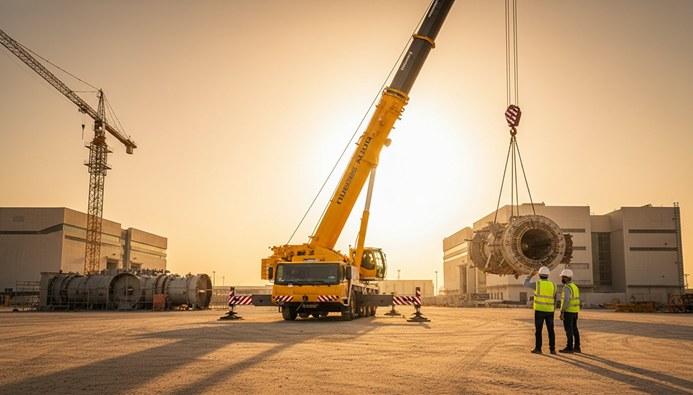
Mobile cranes are designed to move between job sites or different working locations. They may be mounted on wheeled or tracked undercarriages.
Their mobility makes them suitable for construction projects, industrial maintenance, equipment installation, and short-term lifting operations.
FIXED CRANES: POWER AND STABILITY
Fixed cranes are installed permanently or semi-permanently in a particular location.
They are commonly used for repetitive lifting operations in construction sites, factories, warehouses, shipyards, and container terminals.
COMMON TYPES OF CRANES AND THEIR INDUSTRIAL APPLICATIONS
Different types of cranes are designed to meet specific lifting, mobility, height, and operating requirements.
1. ALL-TERRAIN CRANES
All-terrain cranes combine road mobility with the ability to operate on challenging job sites.
These cranes are suitable for construction projects, industrial plant maintenance, and locations requiring both lifting capacity and mobility.
2. CRAWLER CRANES
Crawler cranes operate on tracked undercarriages that distribute the machine's weight over a larger ground area.
They are commonly used in large infrastructure projects, heavy industrial installations, and major construction operations.
Their tracked design provides stability and mobility on suitably prepared ground.
3. ROUGH-TERRAIN CRANES
Rough-terrain cranes are designed for off-road construction environments.
They typically feature large rubber tires, compact configurations, and lifting systems suitable for challenging site conditions.
These cranes are often used in remote construction projects and industrial work sites.
4. TOWER CRANES
Tower cranes are commonly used for high-rise construction and major building projects.
Their tall structures and long horizontal jibs allow materials to be lifted to significant heights and moved across construction areas.
Tower cranes are widely used in urban development projects.
5. OVERHEAD OR BRIDGE CRANES
Overhead cranes are commonly installed in factories, workshops, manufacturing plants, and warehouses.
They travel along elevated runway systems and are used for lifting and transferring heavy materials within a defined working area.
Typical applications include industrial manufacturing, steel handling, machinery assembly, and warehouse operations.
6. GANTRY CRANES
Gantry cranes use a supporting structure with legs that travel on wheels or rails.
They are used for lifting and moving heavy materials in locations such as:
• Shipyards
• Container terminals
• Industrial yards
• Precast concrete facilities
• Manufacturing plants
• Heavy equipment workshops
Gantry cranes can be designed and fabricated for specific industrial lifting requirements.
7. MARITIME AND OFFSHORE CRANES
Maritime and offshore cranes are designed for marine environments and specialized lifting applications.
They are commonly used on offshore platforms, vessels, ports, and marine industrial facilities.
These cranes require appropriate corrosion protection, structural design, and maintenance procedures.
8. FLOATING CRANES
Floating cranes are mounted on barges or specialized vessels.
They provide heavy lifting capabilities for marine construction, port development, bridge projects, and salvage operations.
THE POWER BEHIND THE LIFT: ESSENTIAL CRANE COMPONENTS
Crane performance depends on the correct operation of several structural, mechanical, electrical, and hydraulic components.
Understanding these components helps equipment owners and maintenance teams identify potential problems and maintain reliable operation.
STRUCTURAL AND MECHANICAL COMPONENTS
Boom and Jib
The boom is a primary structural member responsible for providing lifting reach and height.
A jib is an additional extension used to increase reach or support particular lifting configurations.
Hoist and Wire Rope
The hoist system raises and lowers loads using a winch mechanism and lifting rope.
Wire ropes must be inspected for wear, corrosion, deformation, and other signs of damage.
Counterweights
Counterweights help balance lifting forces and maintain crane stability.
The correct counterweight configuration must follow the manufacturer's instructions and the applicable load chart.
Outriggers
Outriggers provide additional stability for many mobile crane configurations.
Their proper deployment and suitable ground support are essential for safe lifting operations.
THE HEART OF THE MACHINE: THE HYDRAULIC SYSTEM
Hydraulic systems play an important role in many modern cranes.
These systems use pressurized hydraulic fluid to transmit power and control mechanical movement.
Hydraulic equipment may operate crane booms, outriggers, steering systems, and other mechanisms depending on the crane design.
HYDRAULIC PUMPS
Hydraulic pumps provide the fluid flow required for hydraulic system operation.
Pump problems can affect lifting performance, operating speed, and hydraulic system efficiency.
Common warning signs include unusual noise, excessive vibration, overheating, and reduced performance.
HYDRAULIC CYLINDERS
Hydraulic cylinders convert hydraulic pressure into linear mechanical movement.
In crane applications, hydraulic cylinders may be used for boom movement, telescoping systems, and outrigger operation.
Cylinder performance can be affected by damaged seals, worn components, scratched piston rods, and internal leakage.
HYDRAULIC HOSES AND FITTINGS
Hydraulic hoses transport pressurized fluid between components.
Correct hose selection, compatible fittings, proper installation, and regular inspection are important for reliable operation.
Hoses may deteriorate due to abrasion, heat, vibration, aging, or incorrect routing.
HYDRAULIC VALVES
Hydraulic valves control fluid direction, pressure, and flow within the system.
Valve problems may affect crane movement, hydraulic response, and overall equipment performance.
HYDRAULIC SEALS
Hydraulic seals help prevent leakage and maintain pressure within pumps, cylinders, and other hydraulic components.
Damaged seals can result in fluid loss, reduced operating efficiency, and additional component wear.
WHY CRANE MAINTENANCE IS CRITICAL FOR SAFETY AND UPTIME
Crane maintenance is essential for operational reliability, equipment protection, and safe lifting operations.
Unexpected crane breakdowns can interrupt construction activities, delay material handling, and increase project costs.
A planned maintenance program helps identify wear and potential failures before they develop into serious equipment problems.
THE COST OF CRANE DOWNTIME
A crane breakdown can affect more than the cost of a replacement component.
Operational consequences may include:
• Delayed construction activities
• Idle workers and equipment
• Interrupted lifting operations
• Increased maintenance expenses
• Delayed material deliveries
• Project scheduling problems
Preventive maintenance can help reduce unexpected equipment stoppages.
COMMON FAILURE POINTS IN CRANE HYDRAULIC SYSTEMS
1. Leaking Hydraulic Hoses and Seals
Continuous pressure, movement, abrasion, and environmental exposure can contribute to hose and seal deterioration.
2. Contaminated Hydraulic Fluid
Dirt, moisture, and metallic particles can damage hydraulic pumps, valves, motors, and other precision components.
3. Hydraulic Cylinder Wear
Worn seals, damaged piston rods, and internal leakage may reduce cylinder performance and affect controlled movement.
4. Hydraulic Pump Problems
Pump wear, cavitation, incorrect fluid conditions, and contamination may reduce hydraulic system performance.
5. Valve Malfunctions
Contaminated or damaged hydraulic valves can interfere with proper fluid control and equipment operation.
IMPORTANCE OF PREVENTIVE CRANE MAINTENANCE
Regular inspections and maintenance help identify potential problems before equipment failure occurs.
Recommended maintenance activities include:
• Inspect hydraulic hoses and fittings.
• Check hydraulic cylinders for leakage.
• Monitor hydraulic fluid condition.
• Inspect pumps and valves for abnormal operation.
• Examine wire ropes and lifting components.
• Check structural components for visible damage.
• Follow the manufacturer's inspection and service intervals.
• Maintain accurate inspection and maintenance records.
Crane inspection frequency must follow applicable regulations, manufacturer instructions, and operating conditions.
Qualified personnel should perform required technical inspections and maintenance.
HYDRAULIC REPAIR AND MAINTENANCE SUPPORT FOR CRANES
Crane hydraulic systems require specialized technical knowledge and appropriate repair procedures.
EMDAD TECHNICAL SERVICES COMPANY (ETS Arabia) supports industrial and heavy-equipment hydraulic requirements through a range of services and products.
Our hydraulic and industrial service areas include:
• Hydraulic pump repair and maintenance
• Hydraulic cylinder repair and servicing
• Hydraulic hoses and fittings
• Hydraulic valve troubleshooting
• Hydraulic seals and spare parts
• Hydraulic power units
• Honed tubes and chrome-plated shafts
• Mechanical maintenance
• Industrial spare parts
• Fabrication and machining
• Technical support and installation
Service suitability depends on the equipment type, component condition, and technical requirements.
YOUR PARTNER IN CRANE RELIABILITY AND PERFORMANCE
From mobile construction cranes to overhead and gantry cranes, reliable lifting equipment depends on properly maintained mechanical and hydraulic systems.
Understanding crane types, essential components, and common maintenance requirements helps businesses make informed equipment and service decisions.
ETS Arabia supports hydraulic and industrial technical requirements for businesses in Dammam, Riyadh, Jeddah, and other locations across Saudi Arabia.
Our team can assist with hydraulic components, repair requirements, industrial maintenance, and related technical solutions.
FREQUENTLY ASKED QUESTIONS ABOUT CRANES
1. What is the difference between a mobile crane and a tower crane?
Mobile cranes are designed to move between working locations and provide flexible lifting solutions.
Tower cranes are generally installed at a fixed location and are commonly used for high-rise construction projects requiring significant lifting height and reach.
2. What are the common causes of crane equipment failure?
Potential causes include inadequate maintenance, hydraulic leakage, mechanical wear, component damage, contamination, and improper operation.
Regular inspection and maintenance help identify developing problems.
3. How often should crane hydraulic systems be inspected?
Inspection frequency depends on manufacturer recommendations, applicable safety requirements, equipment condition, and operating environment.
Pre-operation checks and scheduled inspections by qualified personnel are important parts of crane maintenance.
4. What are the signs of a failing hydraulic pump on a crane?
Common warning signs include unusual noise, excessive vibration, overheating, reduced operating speed, and loss of hydraulic performance.
Professional inspection is recommended when these symptoms occur.
5. Can a hydraulic cylinder on a crane be repaired?
Many hydraulic cylinder problems can be repaired depending on the type and extent of damage.
Possible repairs include seal replacement, rod servicing, and replacement of damaged components.
A technical assessment is necessary to determine whether repair or replacement is appropriate.
6. What is the purpose of hydraulic valves in cranes?
Hydraulic valves regulate the direction, pressure, and flow of hydraulic fluid to control crane functions.
7. Why are hydraulic hoses important in crane operation?
Hydraulic hoses carry pressurized fluid between hydraulic components.
Correctly specified hoses and fittings help maintain system performance and reduce the risk of leakage or failure.
8. Does ETS Arabia provide hydraulic repair services for crane components?
ETS Arabia provides hydraulic pump, cylinder, valve, hose, and related industrial maintenance services.
Contact our technical team with the equipment details to confirm the appropriate service solution.
CONTACT ETS ARABIA
EMDAD TECHNICAL SERVICES COMPANY
Hydraulic Services | Mechanical Maintenance | Industrial Solutions
Phone: +966 55 080 7522
Email: info@etsarabia.com
Website: www.etsarabia.com
Dammam | Riyadh | Jeddah
TECHNICAL SUPPORT • INDUSTRIAL SOLUTIONS • RELIABLE PARTNER